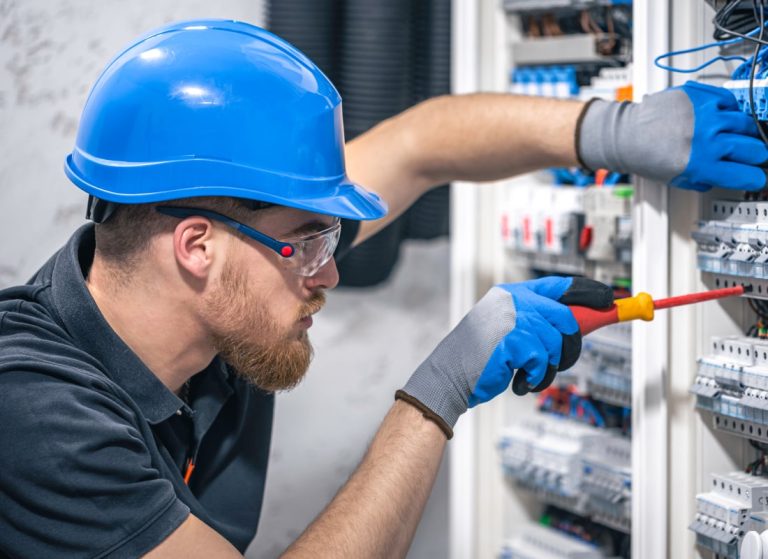
Switchgear rarely gets the attention that transformers or overhead lines do, yet it is the component operators touch most often. When NIKKISO-AYSHA builds or upgrades a distribution network across Pulau Pinang and the northern region, choosing the right switching equipment — and installing it correctly — determines how reliably that network can be operated for the next thirty years.
What does switching equipment do?
Switching equipment, generally called switchgear, is the family of switches, circuit breakers, disconnectors and fuses that control the flow of power through a network. It performs three core jobs: switching load on and off during normal operation, isolation of equipment so it can be worked on safely, and protection — automatically interrupting fault current before it can damage cables, transformers or people.
In Malaysian distribution networks you will find switchgear at every voltage level — 415V low-voltage boards feeding final circuits, and 3.3kV, 11kV and 33kV medium-voltage assemblies at substations. The higher the voltage and the fault level, the more sophisticated the arc-interruption technology has to be, which is where VCBs and SF6 breakers come in.
The main types of switching equipment
Most distribution substations combine several of the following, each suited to a particular role:
- Ring Main Units (RMU) — compact, sealed 11kV switchgear used in distribution rings, allowing a substation to be fed and isolated from either direction.
- Vacuum Circuit Breakers (VCB) — the workhorse breaker for 11kV feeders and transformer protection, interrupting current inside a sealed vacuum bottle.
- SF6 Circuit Breakers — breakers and switches insulated by sulphur hexafluoride gas, common in RMUs and at 33kV.
- Compact Sub Units (CSU) — factory-assembled packages combining switching, transformer and LV distribution in a small footprint.
- LV boards & feeder pillars — 415V switchboards and street distribution units that split supply into final circuits with moulded-case or air circuit breakers.
Vacuum, SF6 or air: how the arc is interrupted
When a circuit breaker opens under load or fault, the contacts draw an electric arc that must be extinguished quickly. The medium used to quench that arc is the defining difference between breaker types:
- Vacuum — a VCB interrupts inside a sealed vacuum interrupter. With almost no matter to sustain it, the arc collapses at the first current zero. Vacuum interrupters are compact, maintenance-light and dominant at 11kV.
- SF6 gas — sulphur hexafluoride is both an excellent insulator and an outstanding arc-quenching gas. SF6 lets designers build very compact, sealed-for-life switchgear, which is why it is so common in RMUs and at 33kV. It must be handled by trained technicians because the gas is a potent greenhouse gas.
- Air — older or lower-voltage equipment relies on air. Air Circuit Breakers (ACBs) remain standard on large 415V LV boards, while air-insulated MV switchgear needs more clearance and space.
Rule of thumb: at 11kV, vacuum interruption paired with air or SF6 insulation dominates; RMUs are usually SF6-insulated for compactness; and at 33kV, SF6 breakers are common. There is no single "best" technology — the right choice depends on fault level, space, environment and maintenance strategy.
Where each type is typically used
- Distribution ring (11kV) — RMUs at each substation node, giving a two-way feed and quick isolation.
- Transformer protection (11kV) — VCB panels or RMU fuse-switch units protecting the incoming transformer.
- Main intake / primary substation (33kV) — SF6 or vacuum breakers with full protection relaying.
- Compact and packaged sites — CSUs where space is tight and a single unit must house switching, transformer and LV distribution.
- Final distribution (415V) — LV boards and feeder pillars with ACBs and MCCBs feeding building and street circuits.

Supply, install, test and commission
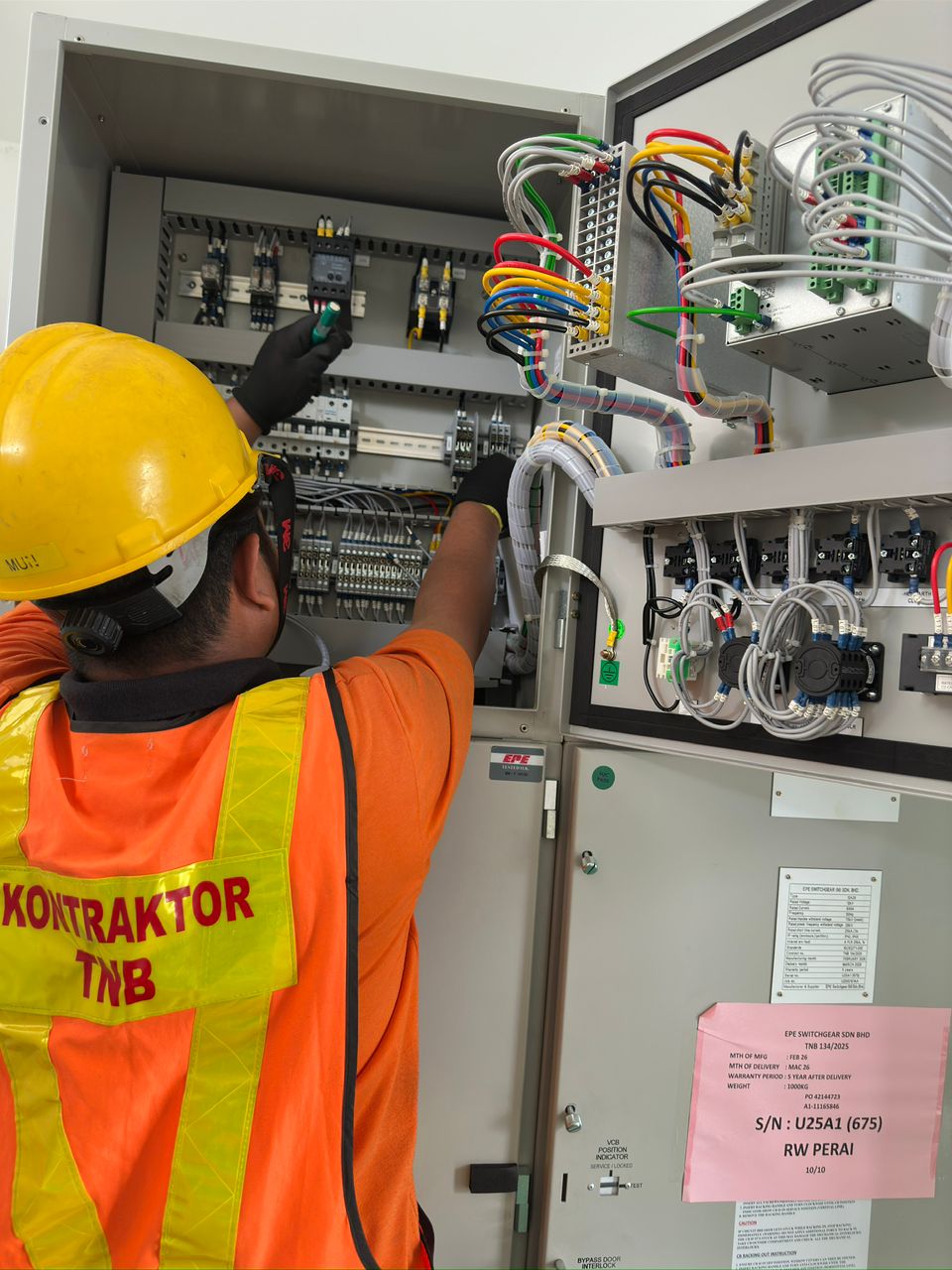
Getting switchgear right is not only about the panel — it is about the full workflow. NIKKISO-AYSHA delivers switching equipment end to end:
- Supply — specifying the correct voltage, rated current, short-circuit rating and interruption medium to match the network and TNB requirements.
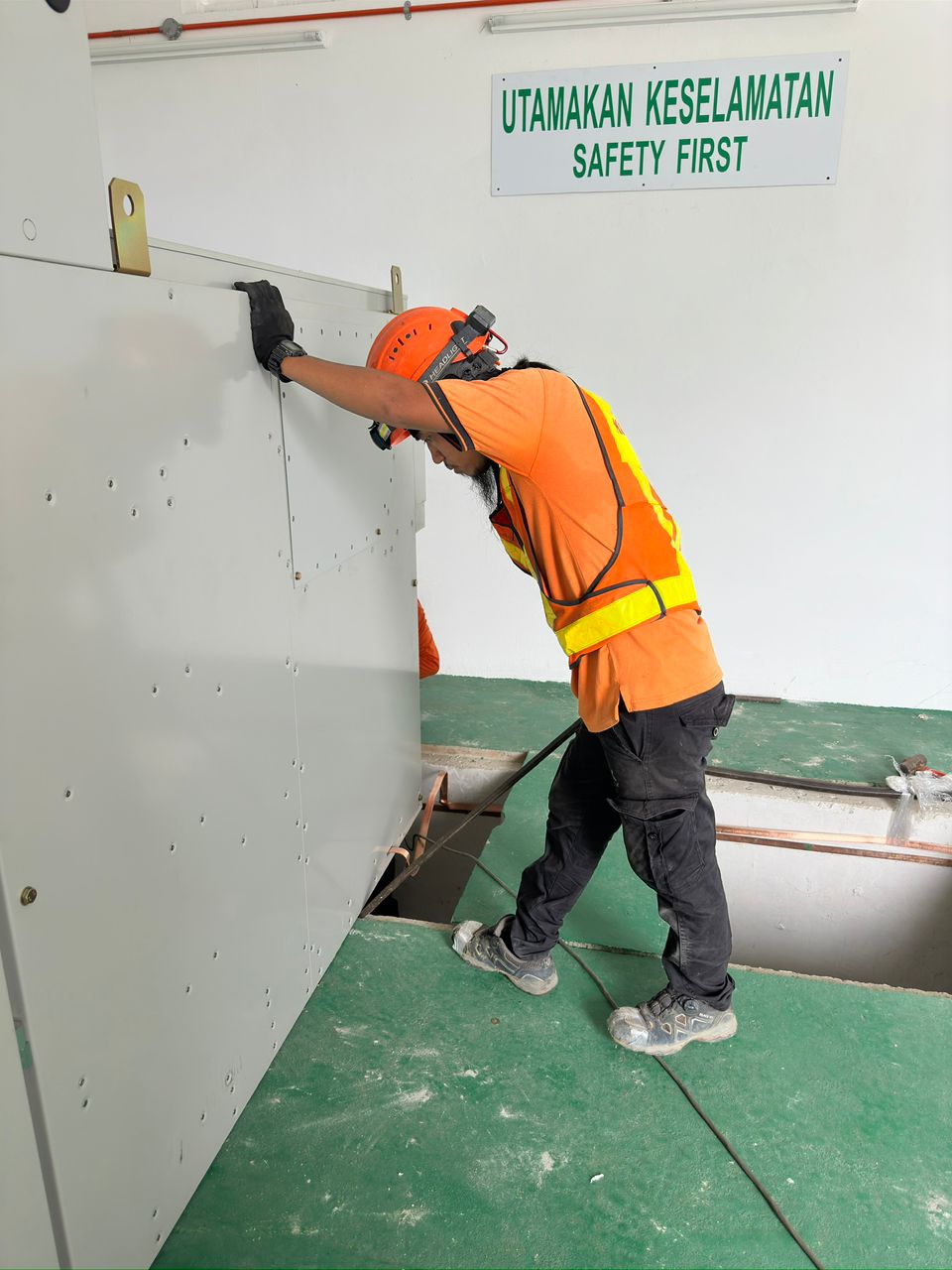
- Install — positioning, levelling and bolting the switchgear, terminating HV and LV cables, and connecting earthing.
- Test — insulation resistance, contact resistance, primary and secondary injection, and relay verification.
- Commission — functional and interlock checks, phasing, and controlled energisation before handover with full documentation.
Maintenance and safety
Modern vacuum and SF6 switchgear is largely maintenance-free internally, but the assembly around it is not. Regular thermographic surveys, mechanism lubrication, interlock checks, SF6 gas-pressure monitoring and contact-resistance measurements keep switchgear dependable. Above all, every operation must respect strict isolation and earthing procedures — medium-voltage switchgear is unforgiving, which is why it must only ever be operated and maintained by competent persons registered with Suruhanjaya Tenaga.
Key takeaways
- Switchgear controls, isolates and protects the network from 415V up to 33kV.
- RMUs serve 11kV rings; VCBs interrupt in vacuum; SF6 breakers use gas insulation and are common in RMUs and at 33kV.
- The interruption medium — vacuum, SF6 or air — is chosen for fault level, space and environment.
- Supply, install, test and commission must all be done by ST-registered competent persons.
Frequently asked questions
What is the difference between a VCB and an SF6 circuit breaker?
A VCB interrupts current inside a sealed vacuum interrupter, where the near-absence of any medium quenches the arc almost instantly and needs little maintenance. An SF6 breaker uses sulphur hexafluoride gas as both insulator and arc-quenching medium. VCBs dominate 11kV distribution, while SF6 is widely used in Ring Main Units and at 33kV.
What is a Ring Main Unit (RMU) used for?
An RMU is compact, sealed 11kV switchgear that combines two ring switches with a transformer protection unit. It lets a substation be fed from either direction along a distribution ring and isolated for maintenance without interrupting supply to the rest of the ring.
Who should supply and commission switchgear in Malaysia?
Only a contractor whose competent persons are registered with Suruhanjaya Tenaga and who works to TNB specifications. NIKKISO-AYSHA is a TNB Rakaniaga Strategik partner with ST-registered engineers for 415V to 33kV switching equipment.