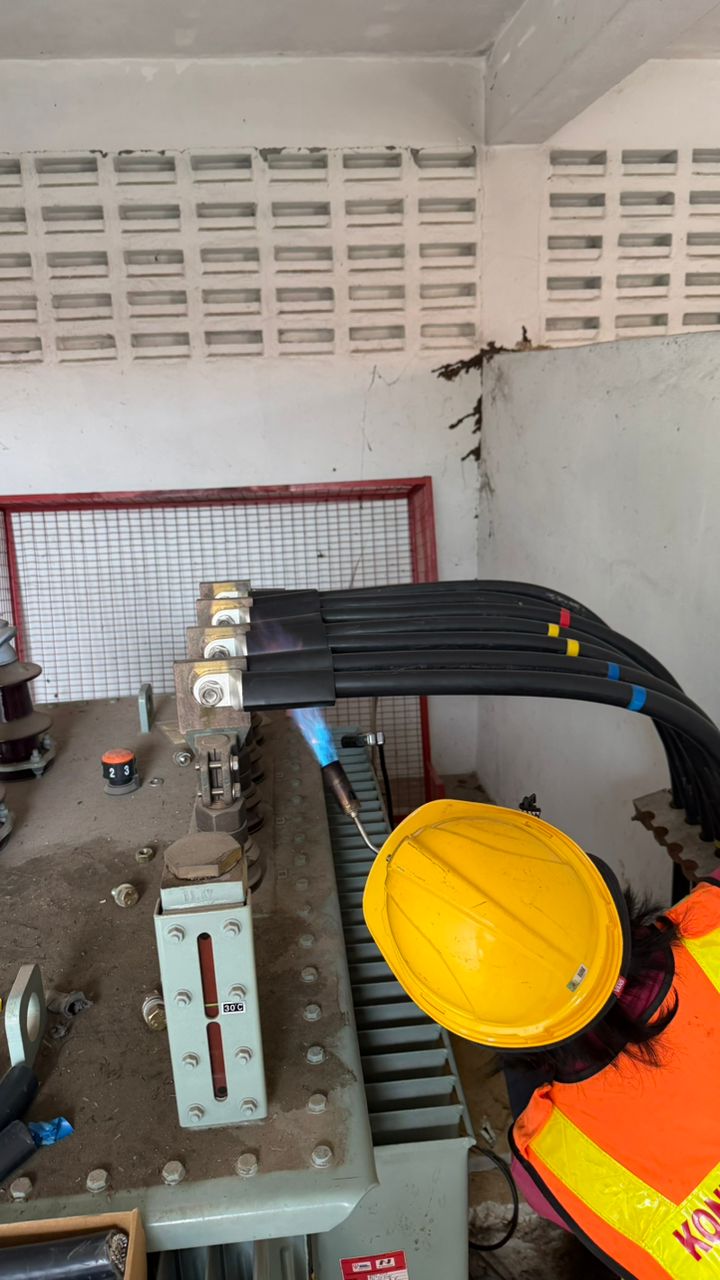
Cable jointing is the craft of connecting two lengths of cable, or terminating a cable onto equipment such as a switchgear, ring main unit or distribution transformer, while faithfully rebuilding every layer the cable is made of. On a medium-voltage cable that means restoring the conductor connection, the insulation, the semiconducting stress-control layers, the metallic screen and the outer sheath — all sealed against moisture. Get any one layer wrong and the joint becomes the weakest point in the whole feeder.
What is cable jointing and why it is critical
A cable joint or termination is, electrically, the most demanding point on a run. The factory-made cable has perfectly concentric, void-free insulation; a field joint has to reproduce that by hand, often in a cramped trench in the Pulau Pinang heat. This is why Tenaga Nasional Berhad (TNB) only accepts jointing work from approved contractors, and why Suruhanjaya Tenaga requires competent persons for high-voltage terminations. The two systems that make a reliable field joint achievable are heat-shrink and cold-shrink.

How heat-shrink cable jointing works
Heat-shrink systems use tubes and sleeves made from cross-linked polymer that have been expanded during manufacture. When the jointer applies controlled heat — usually from a gas torch or hot-air gun — the material "remembers" its original moulded size and shrinks tightly down onto the cable, following every contour. Modern heat-shrink kits combine several functions in engineered layers: adhesive-lined sleeves that seal out moisture, stress-control tubing that manages the electrical field at the screen cut-back, and thick insulating sleeves rated for the working voltage.
- Flame-applied: the installer works progressively along the joint, watching for the material to change appearance as it recovers.
- Wide size range: because the tubing recovers over a large diameter range, a single kit often covers several cable sizes.
- Tolerant of surfaces: the adhesive-lined design copes well with slightly irregular or older cable.
How cold-shrink cable jointing works
Cold-shrink systems reach the same goal without any flame. The insulating and stress-control components are moulded from a high-quality elastomer — typically silicone or EPDM rubber — and pre-stretched over a removable spiral core at the factory. On site the jointer slides the assembly into position and simply pulls out the core; the elastomer springs back onto the cable and grips it under constant, controlled pressure. Because the rubber stays permanently elastic, it keeps hugging the cable even as loads heat and cool the joint over the years.
- No open flame: ideal for confined trenches, gassy or fire-sensitive locations and safety-critical sites.
- Fast and repeatable: far less installer-to-installer variation because there is no heating skill involved.
- Constant radial pressure: the living elastomer maintains its seal and interface pressure for the life of the joint.
The bottom line: heat-shrink relies on the installer's heating skill to make a good joint; cold-shrink builds that consistency into the product. But cold-shrink demands accurate cable dimensions and cleaner conditions, because there is no adhesive to hide behind.
Heat-shrink vs cold-shrink: pros and cons
Neither method is universally "best" — each wins on different sites. Here is how they compare on the factors that matter most in the field:
- Speed: cold-shrink is generally quicker; heat-shrink takes longer because each sleeve must be heated evenly.
- Weather sensitivity: heat-shrink struggles in rain and wind, which cool the flame and can trap moisture; cold-shrink is far less affected and can be installed in damp conditions once the cable is dry and clean.
- Skill dependency: heat-shrink is skill-intensive (too little heat under-recovers, too much scorches the polymer); cold-shrink is more forgiving of operator technique.
- Reliability: both are highly reliable when installed correctly; cold-shrink's constant pressure gives it an edge against thermal cycling and load fluctuations.
- Cost: heat-shrink materials are usually cheaper per kit, but cold-shrink can lower total cost through faster installs and fewer call-backs.
- Cable size range: heat-shrink covers a wider diameter range per kit, useful for mixed or unknown cable sizes.


When to use which technique
Our jointers choose the system to suit the cable and the site rather than defaulting to one method:
- Confined or wet locations — cold-shrink, because the flame-free process is safer and unaffected by damp trenches.
- Fire-sensitive or occupied premises — cold-shrink, where an open torch is undesirable.
- Mixed or older cable of uncertain diameter — heat-shrink, whose wide recovery range and adhesive lining accommodate variation.
- Budget-driven LV work with skilled jointers on hand — heat-shrink often gives the lowest material cost.
- 11kV and 33kV terminations onto switchgear or transformers — either can be used with approved kits; cold-shrink is increasingly preferred for its consistency at higher voltages.
Common causes of cable joint failure
Whichever system is chosen, the same handful of mistakes account for most premature failures — and every one is preventable with disciplined workmanship:
- Moisture ingress: water reaching the insulation triggers treeing and breakdown. Correct sealing and dry working conditions are essential.
- Poor surface preparation: incorrect strip lengths, contamination, or leftover semiconductor residue disrupt the electrical field.
- Air voids: gaps trapped in the insulation cause partial discharge that slowly erodes the joint from the inside.
- Heating errors (heat-shrink): under-heating leaves the sleeve loose; over-heating scorches and weakens the polymer.
- Skipped stress control: omitting or misplacing the stress-control layer concentrates voltage stress at the screen cut and leads to flashover.
Why a licensed TNB contractor matters
Cable jointing looks straightforward but is unforgiving of shortcuts. A reliable joint depends on trained hands, the correct approved kit for the exact cable, calibrated tooling and clean discipline in the trench. As a TNB Rakaniaga Strategik (Strategic Business Partner) and ST-registered contractor operating since 1993 from Pulau Pinang, NIKKISO-AYSHA has completed thousands of LV, 11kV and 33kV joints and terminations across Penang and the northern region — backed by 30+ years of experience and jointers trained on the manufacturer-approved systems TNB accepts.
Key takeaways
- Heat-shrink uses torch-applied cross-linked polymer; cold-shrink uses pre-stretched elastomer that springs back with no flame.
- Cold-shrink wins on speed, wet-weather tolerance and consistency; heat-shrink wins on cable-size range and material cost.
- Most joint failures come from moisture ingress, poor preparation and air voids — all preventable.
- High-voltage jointing in Malaysia must be done by ST-registered competent persons and, for TNB work, an approved contractor.
Frequently asked questions
What is the difference between heat-shrink and cold-shrink cable jointing?
Heat-shrink jointing uses cross-linked polymer sleeves that shrink onto the cable when heated with a gas torch. Cold-shrink uses pre-stretched elastomeric tubes held open by a removable core — pulling the core lets the tube spring back onto the cable with no flame. Cold-shrink is flame-free and faster; heat-shrink is more forgiving of cable size variation.
Is cold-shrink better than heat-shrink for cable joints?
Neither is universally better. Cold-shrink is faster, needs no open flame and applies constant pressure for the life of the joint, suiting confined trenches and wet weather. Heat-shrink handles a wider diameter range, tolerates rougher surfaces and is often cheaper. The right choice depends on voltage, environment, installer skill and site conditions.
What causes cable joints to fail?
The most common causes are moisture ingress, poor surface preparation and air voids in the insulation. Contamination, incorrect stripping dimensions, over- or under-heating of heat-shrink sleeves, and skipped stress-control layers also lead to partial discharge and breakdown. Correct preparation by a competent jointer prevents most failures.
Who can carry out 11kV and 33kV cable jointing in Malaysia?
High-voltage jointing must be done by competent persons registered with Suruhanjaya Tenaga and, for TNB networks, by an approved TNB contractor. NIKKISO-AYSHA is an ST-registered, TNB Rakaniaga Strategik contractor whose jointers are trained on approved 11kV and 33kV joint and termination kits.