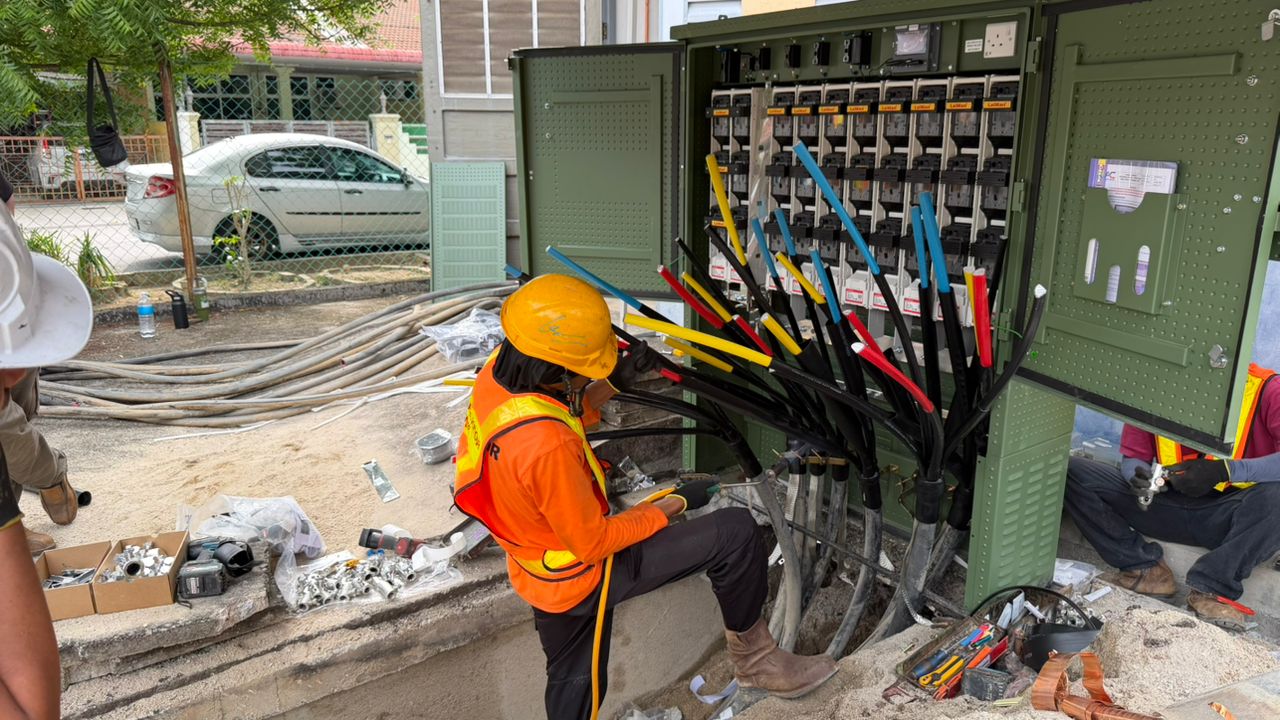
Whether it is a rural feeder in Kedah or a new gated development in Pulau Pinang, the choice between overhead and underground cabling shapes the reliability, appearance and cost of the supply for decades. As a licensed TNB contractor, NIKKISO-AYSHA installs both, and the right answer always depends on the site, the voltage level and the client's priorities.
How overhead lines are installed
Overhead distribution carries the conductors in the air, supported by poles or lattice towers. For LV and 11kV distribution the conductors are usually ACSR (aluminium conductor steel-reinforced) bare lines or aerial bundled cable, held clear of the ground on insulators. The steel core gives the conductor the mechanical strength to span between supports without sagging into trees or structures.
Installation is comparatively fast: dig and set the poles, string the conductors, fit insulators and stays, and connect the transformers and drop-outs. Because everything is visible and accessible, an overhead network is quick to build and quick to inspect — which is exactly why it dominates long rural runs.

How underground cables are installed
Underground distribution buries the cables below the surface, almost always using XLPE (cross-linked polyethylene) insulated LV and HV cable. The route is excavated to a trench, the cable is laid on a bedding layer of soft sand, then covered with more sand, protective cable tiles or covers, and a brightly coloured warning tape before the trench is backfilled and reinstated. Cable route markers are set at the surface so the buried route can be traced later.
At road crossings, building entries and other hard points, the cable is drawn through ducts rather than direct-buried, so it can be pulled in or replaced without re-digging the road. Every run is tied together with jointing and termination — the most skilled part of the job — before the cable is tested and energised.
Underground vs overhead: the real trade-offs
Choosing between the two is a balance of the following factors:
- Cost — Overhead is significantly cheaper and faster to install; underground can cost several times more because of excavation, ducting, sand and reinstatement.
- Reliability — Underground wins clearly. Buried cables are shielded from wind, falling trees, kites, vehicle strikes and lightning, so they fault far less often.
- Safety — Underground removes live conductors from public reach, eliminating most contact and clearance hazards; overhead lines carry ongoing clearance and safety-distance risks.
- Aesthetics — Underground leaves the streetscape clear of poles and wires, which is why modern residential developments increasingly demand it.
- Fault-finding & repair time — Overhead faults are usually visible and repaired quickly; underground faults are hidden and must be located, excavated and jointed, making repairs slower.
- Weather & lightning exposure — Overhead lines are directly exposed to storms and lightning; underground cables are largely immune.
- Maintenance — Overhead needs regular tree trimming and visual patrols; underground needs little routine maintenance once installed, but any intervention is more disruptive.
The core trade-off: Overhead lines fault more often but are repaired fast; underground cables rarely fault but take longer to fix when they do. Underground buys you reliability and safety up front — you pay for it in installation cost and slower repairs.
When to choose each in Malaysia
In practice the decision usually follows the environment:
- Urban and township areas — Underground is preferred (and often mandatory) for reliability, safety and a pole-free streetscape.
- New residential and commercial developments — Underground XLPE feeders with feeder pillars are now the standard for gated communities and new housing schemes.
- Rural and long-distance feeders — Overhead lines are the economical choice where distances are long and land is open.
- Temporary or fast-track supplies — Overhead can be built quickly when speed and low cost matter more than appearance.


Best practices for underground cable laying
The reliability that makes underground attractive only holds if the installation is done correctly. On every project our crews apply the following standards:
- Trenching depth — Lay to the correct cover for the voltage: around 0.6 m for LV and about 0.9 m for 11kV HV, deeper under roads and crossings.
- Bedding sand — Sit the cable on a clean, soft sand bed and surround it with sand so no stones bear on the insulation, protecting it from mechanical damage and heat build-up.
- Ducting — Use ducts at road crossings and building entries so cables can be pulled in or replaced without excavation, and seal duct ends against water and vermin.
- Warning tape & markers — Lay coloured warning tape above the cable and install route markers so future excavation does not strike the cable.
- Jointing & termination — Carry out joints and terminations in clean, dry conditions by trained jointers, as this is where most underground faults originate.
- Testing before energisation — Insulation-resistance and, where required, pressure testing confirms the cable is sound before it is put into service.
Why use a licensed TNB contractor?
Cable laying is deceptively technical: get the depth, bedding, ducting or jointing wrong and a "reliable" underground network becomes a string of repeated faults. As a TNB Rakaniaga Strategik (Strategic Business Partner) with 30+ years of experience since 1993, NIKKISO-AYSHA has laid, jointed and commissioned LV and HV cable across Pulau Pinang and the northern region, always to TNB specifications and Suruhanjaya Tenaga (Energy Commission) requirements.
Key takeaways
- Overhead lines are cheaper, faster and easier to fault-find; underground cables are more reliable, safer and weather-proof.
- Underground uses XLPE cable in a sand-bedded trench or ducts, with warning tape and route markers.
- In Malaysia, urban areas and new developments favour underground; rural and long feeders favour overhead.
- Correct trenching depth, bedding, ducting and jointing are what make an underground network dependable.
Frequently asked questions
Is underground or overhead cabling better in Malaysia?
Neither is universally better. Overhead lines are cheaper, faster to install and easier to fault-find, which suits rural and long-distance feeders. Underground XLPE cables cost more but are far more reliable, safer and unaffected by lightning, wind and trees, making them the standard for urban areas and modern residential developments in Penang.
How deep should underground power cables be buried?
Under TNB practice, LV cables are typically laid around 0.6 m deep and 11kV HV cables around 0.9 m deep, deeper under roads. Cables sit on a sand bed, are covered with sand and protective tiles, and a coloured warning tape is placed above them before backfilling, with route markers at the surface.
Why do underground cable faults take longer to repair?
An overhead fault is usually visible and reached quickly. An underground fault is hidden, so the cable must first be located and pinpointed, then excavated, jointed and reinstated — slower to fix, even though underground cables fault far less often.
What cable is used for underground power distribution in Malaysia?
Underground LV and 11kV/33kV HV distribution predominantly uses XLPE (cross-linked polyethylene) insulated cable, either direct-buried in a sand-bedded trench or drawn through ducts at crossings and building entries.